
Unicellular Organisms
Some living organisms are made up of once cell only, these are called unicellular. These organisms have a large surface area to volume ratio and rely on simple diffusion to meet their needs. An example of a unicellular animal is Amoeba.
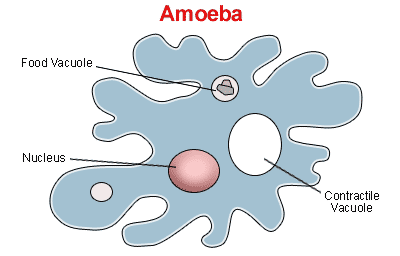
All seven life processes take place inside this one cell. Amoebas are found in ponds and ditches. They move by changing their shape, they push out pseudopodia in the direction they want to move and the rest of the cell flows after them. Amoeba feed on smaller organisms such as bacteria. The pseudopodia flow around the food engulfing it, the food is then taken into the cytoplasm in a food vacuole. Enzymes further break down the food.
Useful substances that the amoeba requires like Oxygen pass into to the amoeba from the water around by diffusion and waste substances such as carbon dioxide pass out into the water also via diffusion.
Multicellular Organisms
Multicellular organisms are those which are made up of many cells. Humans are multicellular. Multicellular organisms can be much larger and more complex. This is because the cells of the organism have specialised into many different types of cells such as nerve cells, blood cells, muscle cells all performing different functions.