This Topic Contains
Related Topics
GCSE Physics
All Topics


Diodes, LDRs and Thermistors

Bookmark and Share

The Diode

A diode allows a current to flow through it in one direction only.

It has the symbol:
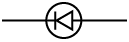
Remember circuit diagrams are drawn in conventional current. So the arrow on the diode symbol indicates the direction in which the conventional current can flow.

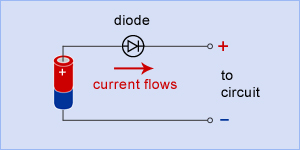
  • When the arrow of the diode is in the same direction as the conventional current flow it is said to be forward biased and current flows.

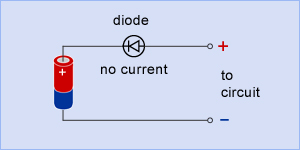
  • When the arrow of the diode is in the opposite direction to the conventional current flow it is said to be reversed biased and no current flows.

Content on this page requires a newer version of Adobe Flash Player.

Get Adobe Flash player

Diodes are used in electric circuits to protect electrical equipment. In electrical equipment such as radio or computers damage can be caused if the battery is connected the wrong way round. A diode in the circuit only allows the current to pass through when the battery is connected correctly. If the battery is connected the wrong way round no current passes through the diode and the electrical circuit for the equipment is protected from damage.
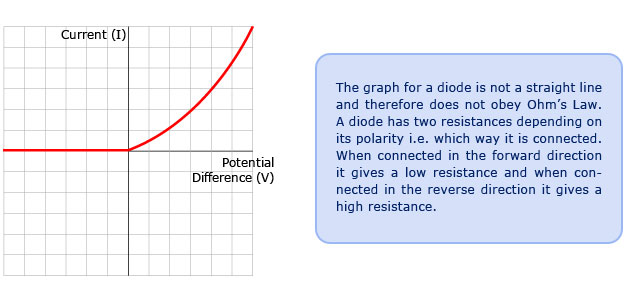
Current – Potential Difference graph for a Diode

top

The Light-Dependent Resistor (LDR)

In a light-dependent resistor the resistance decreases as the light intensity (brightness of light) increases.

It has the symbol:

  • At low light levels or in the dark the resistance of an LDR is high and little current flows through it.

  • In bright light the resistance of an LDR is low and more current flows through it.

The properties of an LDR are put to use in digital camera. The shutter speed of a camera can be controlled by an LDR. If light levels are low changes in the resistance of the LDR can be measured causing the shutter to stay open for longer. An LDR can also be used in a burglar alarm circuit for e.g. inside a safe. When the safe is closed it is dark and so the resistance of the LDR is high. If it is opened and the LDR exposed to light the resistance drops allowing current to flow which can then trigger a relay circuit which rings an alarm.

Current Potential graph for a Light - Dependent Resistor (LDR)

top

The Thermistor

A thermistor is an electrical component in which the resistance decreases as the temperature increases.

It has the following symbol:

  • At low temperature the thermistor has a high resistance and little current can flow through it.

  • But at high temperatures the resistance of the thermistor is low and more current flows through it.

It is this property of the thermistor that allows it to be used as a temperature sensor. A Thermistor can be used as an electronic thermometer in which the current flowing through it at different temperatures can be calibrated in degrees Celsius to give a temperature reading. A thermistor is also used in a fire alarm. A thermistor is placed into a fire alarm circuit such that above a set temperature the current through the thermistor is at an amount to trigger a relay circuit which rings an alarm.

Current Potential graph for a Thermistor

top
HomeContact Home