This Topic Contains
Waves
GCSE Physics
All Topics


Total Internal Reflection

Bookmark and Share

Refractive Index

We know the speed at which a wave travels is dependant upon the medium it travels through. A number called the refractive index of a substance is a measure of how much the speed of a wave changes compared to the speed in a reference medium i.e. air or a vacuum.

For light waves the refractive index is given as

The refractive index for glass is approximately 1.5; this means the speed of light in glass is approximately 1.5 times slower than the speed of light in air. Similarly, the refractive index of water is 1.33.  This implies that light rays will not be bent as much in water as they are in glass as they are not slowed down as much in water.

top

Total Internal Reflection

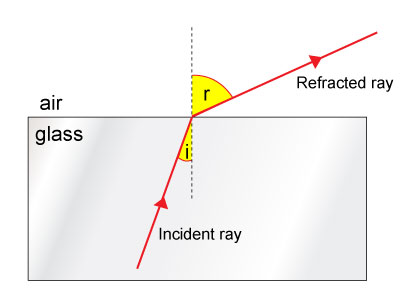
When light travels from one medium to another it changes speed and is refracted. If the light rays are travelling for a less dense material to a dense medium they are refracted towards the normal and if they are travelling from a dense to less dense medium they are refracted away from the normal.

For total internal reflection to occur the light must travel from a dense medium to a less dense medium (e.g. glass to air or water to air).

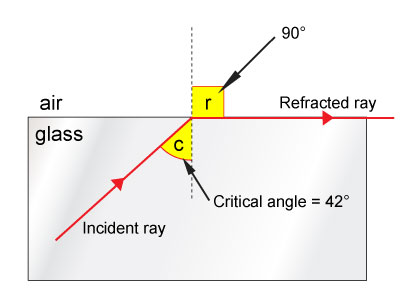
As the angle of incidence increases so does the angle of refraction. When the angle of incidence reaches a value known as the critical angle the refracted rays travel along the surface of the medium or in other words are refracted to an angle of 90°. The critical angle for the angle of incidence in glass is 42°.

1. Angle of incidence less than the critical angle
When the angle of incidence of the light ray leaving the glass is less than the critical angle, the light ray speeds up on leaving the glass and is refracted away from the normal.
2. Angle of incidence equal to the critical angle
When the angle of incidence of the light ray reaches the critical angle (42°) the angle of refraction is 90°. The refracted ray travels along the surface of the denser medium in this case the glass.
3. Angle of incidence greater than the critical angle
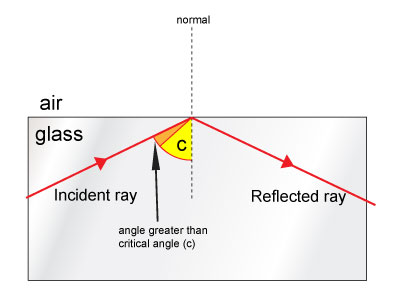
When the angle of incidence of the light ray is greater than the critical angle then no refraction takes place. Instead, all the light is reflected back into the denser material in this case the glass. This is called total internal reflection.
TIP  

In order for total internal reflection to take place;

  1. The rays of light must travel from a dense medium to a less dense medium.
  2. The angle of incidence must be greater than the critical angle.
top

Optical Fibres

Optical fibres are used extensively in the field of telecommunications and medicine. In the telecommunication field they are used as an alternative signal carrier to copper wires in the telephone system. They are used to carrier digital signals in the form of light pulses over long distances.

Optical Fibre

Content on this page requires a newer version of Adobe Flash Player.

Get Adobe Flash player

An optical fibre consists of a very thin core of high purity glass. The core is covered by a second layer (cladding) also made from high purity glass. The cladding is less dense than the core and has a lower refractive index. Remember, for total internal reflection to occur the light rays must travel from a dense medium to a less dense medium. Thus light rays passing along the core at an angle greater than the critical angle are totally internally reflected. The surface of the high purity glass core acts like a perfect mirror and the light ray is continuously reflected along the length of the optical fibre core. The cladding is covered with a protective plastic buffer coating.

Advantages of Optical Fibres

Cost

Optical fibres are less expensive than copper wires.

Smaller Diameters

Optical fibres are thinner than copper wires allowing more fibres to be bundled together in a given cable diameter. This allows for more information be it telephone conversations or television channels to be passed through the cable.

Interference

Electrical signals in copper wires interfere with other copper wires bundled in the same cable. As optical fibres carry light signals there is no interference between fibres bundled in the same cable resulting in a clearer signal.

Power Transmitters

Due to little degradation of the optical fibre signal the signal only needs to be boosted after long distances approximately 100km whereas for cooper cables this needs to be done a lot more often after approximately 8km. Thus optical fibres require less power for transmission.

top
HomeContact Home