
Electromagnetic Radiation
Although the electromagnetic spectrum is made up of many different waves with different properties, they are all electromagnetic radiations.
Electromagnetic radiations can be considered as a stream of photons. Photons are particles of zero mass and charge which travel in a wave like pattern at the speed of light. Each photon has a certain quantity or pattern of energy.
Thus a beam of electromagnetic radiation delivers energy in photons and the difference between the various electromagnetic radiations is the amount of energy within the photons they possess. Electromagnetic radiations with high frequencies such as gamma rays and X-rays have photons of high energies whereas electromagnetic radiations with low frequencies such as radio waves have photons of low energies. The energy delivered by each electromagnetic radiation beam increases with the frequency of the electromagnetic wave.
Intensity of an Electromagnetic Radiation beam
The intensity of a beam of electromagnetic radiation is the energy it delivers per second. The energy of the beam of electromagnetic radiation is delivered by the photons. Therefore the intensity depends on two things:
- The number of photons that are arriving per second
- The amount of energy carried by each photon
1. The number of photons arriving per second
The two microwave ovens above have the same type of electromagnetic radiation source in the form of microwaves. However the one on the left is more powerful and cooks the chicken quicker. This is because the more powerful microwave oven has more photons arriving per second on the chicken thereby increasing the intensity of the electromagnetic radiation beam. |
2. The amount of energy carried by each photon
High frequency radiations have high energy photons. Therefore, if a gamma ray source was emitting the same photons per second as an infrared source the intensity from the gamma rays would be higher as the photons from this source carry a greater amount of energy than infrared source. Infrared have a smaller frequency than gamma rays and so the photons have a smaller amount of energy.
Gamma Rays

Wavelength 10−12 meters
Frequency 1020 Hertz
Energy 107 Electron Volts
The ionising nature of gamma rays has been used by medicine to its advantage. By carefully directing and controlling a beam of gamma radiation onto cancer cells they can be destroyed and their development controlled. Gamma rays are used to sterilise food and hospital equipment. Gamma rays kill bacteria and mould in food prolonging its shelf life.
X-Rays
Wavelength 10−10 meters
Frequency 1018 Hertz
Energy 105 Electron Volts
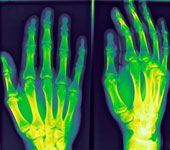
X-rays are mainly used in the field of medicine. They are used to produce images of bones and teeth vital for diagnosis and treatment. By placing a photographic film underneath the area of interest and directing a beam of x-rays an image is produced on the film. Parts of the body where the x-rays pass through easily are shown up as dark areas on the film. Where the x-rays find it difficult to penetrate such as bones or teeth shown up as lighter areas on the film. Like gamma rays the ionising potential of x-rays can also be used in the treatment of cancer. X-rays are also used in airports to check baggage and in industry as a quality control tool for e.g. to check packaged food do not contain metal or stones.
Ultraviolet Rays

Wavelength 10−8 meters
Frequency 1016 Hertz
Energy 102 Electron Volts
Ultraviolet radiation is produced by hot objects such as the sun or by the high temperature sparks produced during electric welding. Ultraviolet rays have less energetic photons compared to gamma rays and x-rays and a lower penetration power. Their effect on humans is therefore limited to the skin. Exposure to ultraviolet rays can cause a suntan (pigmentation of the skin) and sunburn. At high levels of exposure skin cancer can result and damage to the retina. This why sunscreen and glasses with ultraviolet protection are important.
Fortunately most of the ultraviolet radiation in sunlight is absorbed by the oxygen in the ozone layer of the Earth’s atmosphere.
Ultraviolet is used in detecting forged bank notes – forged notes glow differently in ultraviolet light. Security pens for marking goods contain a special ink which only shows up under ultraviolet light.
Ultraviolet has positive effects on the human body as it stimulates the production of vitamin D. It is used in the field of medicine for phototherapy in the treatment of some skin disorders.
Ultraviolet radiations kill microbes and are used in the sterilisation of surgical equipment.
Fluorescent lamps make use of ultraviolet radiations. When an electric current passes through a mercury vapour ultraviolet rays are produce. These rays collide with fluorescent powder on the inside of the tube making them fluoresce and converting the energy to visible light. Fluorescent lamps are more efficient than ordinary filament lamps.
Visible Light

Wavelength 10−7 meters
Frequency 7.5 x 10¹⁴ Hertz
Energy 101 Electron Volts
This is the small part of the electromagnetic spectrum that is detectable by the human eye. All objects with enough heat to glow emit light waves. The sun is the main source of light. Light bulbs work on the heating effect caused by electrical resistance in a filament lamp to cause it to glow and emit light.
White light is made up of a mixture of colours. This spectrum of colours making up white light can be viewed when light is dispersed such as in a rainbow. The colours, in order are red, orange, yellow, green, blue, indigo and violet.
Human sight makes use of the wavelengths from visible light, thus we need light in order to see.
Light plays a critical role in communication systems. Lighthouses use light to communicate the potential hazards along a stretch of coastline. Morse code between ships during radio silence can be achieved using a flash light.
Transmitting light through air has setbacks in that the transmitter and receiver must be in view of each other. Also light waves are absorbed by rain, fog and other bad weather conditions. These setbacks were resolved with the advent of optical fibres. Optical fibres are made from very pure glass and allow light waves carrying information to travel through them using the principle of total internal reflection. The information the light waves carry is digital and is in the form of 1’s and 0’s. As the light wave carries a digital signal, it is of high quality and does not get weaker over long distances. Light waves are therefore used to carry vast amount of information at high speeds through optical fibre systems making the extremely important in the field of communications.
Infrared
Wavelength 10−5 meters
Frequency 4 x 10¹⁴ Hertz
Energy 10−1 Electron Volts
All objects above the temperature of absolute zero (-273°C) emit infra-red radiation. In other words all warm objects give off infra-red rays.
Infra-red radiations cannot be seen by the human eye but their effects can be sense by the skin as warmth.
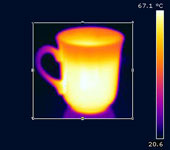
Thermal imaging cameras make use of infra-red radiations emitted from objects to form an image. These are used by firemen to detect people where visibility is severely reduced by smoke. Police also use thermal imaging cameras to track criminal during the night. Thermal imaging cameras are also used to produce thermographs of objects so the heat loss from them can be studied. For example a thermograph of a house can give information about where the main areas of heat loss are therefore ensuring the correct areas are insulated.
Infrared waves are also used as a source for carrier signals in fibre optics.
Burglar alarms use sensors which detect the infra-red rays given off by intruders.
Microwaves

Wavelength 10−3 meters
Frequency 1010 Hertz
Energy 10−4 Electron Volts
Microwaves are categorised as radio waves. They have the shortest wavelengths of all the radio waves.
Microwaves are non ionising radiations. Their frequencies are a lot lower than those of gamma rays and x-rays and the energy of their photons is considerably lesser. They therefore do not have the damaging properties of ionising radiations. However, in sufficient intensity they can cause molecules in matter to vibrate which in turn cause friction and produces heat. This heating effect of microwaves does present a risk to living tissue.
The property of microwaves to cause molecules to vibrate is put to use to cook food in microwave ovens. In a microwave oven the microwaves are produced by a device called a Magnetron. These produce microwaves of a longer wavelength (approximately 10 to 20 cm). The microwaves are absorbed by the water and the fat molecules in the food heating them up from inside thereby cooking the food. Microwaves are not absorbed by dry materials such as glass and ceramics. The food is placed on a turntable to ensure the even distribution of the microwaves to allow the food to be cooked evenly. The metal casing of the microwave oven ensures all the microwaves are reflected back into the oven and the door has a wire mesh over the window which serves the same purpose.
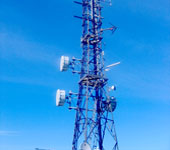
Microwaves can penetrate clouds, light rain, snow, haze and smoke. This makes them good for transmitting information from one place to another. Microwaves can be focussed into highly directional beams using parabolic dish antennas. These beams can be directed like a searchlight to a receiving aerial based on the Earth or to a satellite orbiting the Earth. Microwaves are the principle carriers of telegraphic data transmission (mobile phones) and also carry television transmissions.
Radio waves
Wavelength 10−3 to 105 meters
Frequency 1010 to 104 Hertz
Energy 10−5 Electron Volts
Radio Spectrum
Super High Frequencies(SHF) 3 - 30GHz
Ultra High Frequencies (UHF) 0.3 - 3GHz
Very High Frequencies (VHF) 30 - 300MHz
High Frequencies (HF) 3 - 30MHz
Medium Frequencies (MF) 0.3 - 3MHz
Low Frequencies (UF) 30 - 300kHz
Very Low Frequencies (VLF) 3 - 30kHZ
GHz = Giga Hertz = 109 Hertz
MHz = Mega Hertz = 106 Hertz
kHz = Kilo Hertz = 103 Hertz
Radio waves are used in communication. Radio waves are not strongly absorbed by the atmosphere and can therefore travel long distances. Radio waves make use of the ionosphere a region of the atmosphere about 100km above the Earth’s surface and approximately 300km thick. In the ionosphere the atmosphere is partially ionised by the action of ultraviolet radiations from the sunlight. Radio waves are bent and reflected back towards the Earth by the ionosphere. This bouncing off the ionosphere and the Earth’s surface may occur repeatedly allowing radio waves to travel long distances around the Earth.